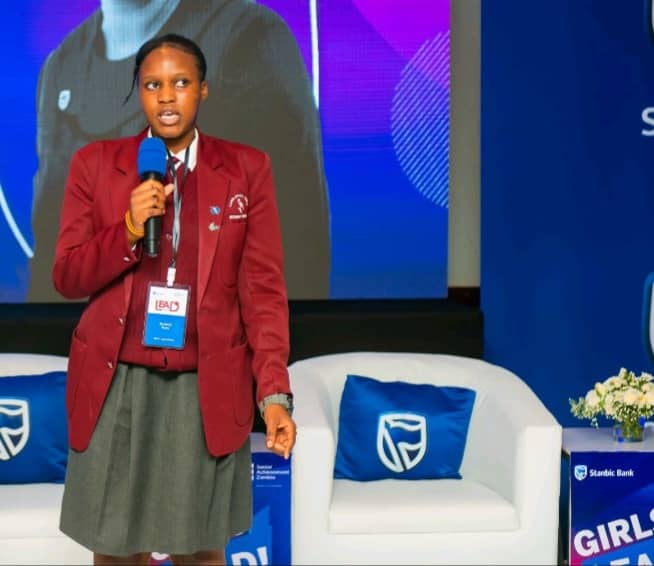
Jeannette Ilunga, Southern Sun Ridgeway Hotel, LUSAKA | Wednesday 1 October, 2025 – When Rabecca Kaira sat down with me, it seemed clear from her expressive gestures and body language that the National Aeronautics and Space Administration (NASA) was still vivid in her mind. She had been there herself, walking through a place where real spacecraft are assembled and real futures get mapped. She is seventeen, finishing her final year at Kabulonga Girls Secondary School, and she has already travelled further than most young people could dream of. Yet when she talks about everything she has accomplished, one question keeps surfacing.
"How will somebody know my brilliant idea if I am not confident to speak up for myself?"
It is the kind of question that sounds simple until you realise how much weight it carries. Rabecca started asking herself this somewhere between winning a national business competition in Zambia and flying to Mauritius to represent her country. Somewhere between learning to code in Virginia and realising aerospace engineering might actually be her calling. Somewhere between being named CEO of a student company and understanding that leadership is less about the title and more about finding your voice when it matters.
Where Science Meets Advocacy
When I asked Rabecca how she sees herself, two descriptions came immediately: tech enthusiast and cultural ambassador. Both fit comfortably, reflecting different but compatible sides of who she is.
It was computer programming that grabbed her attention first. She loves the way logic meets creativity, the way problems get solved one line of code at a time but then she visited NASA during her exchange program in the United States, and everything felt more complicated. Aerospace engineering suddenly became a real possibility, a path she could actually see herself taking. Now she has to figure out whether to choose one or somehow bring both together.
What strikes me about Rabecca is how naturally she connects science with advocacy. She wants to work on clean water access in Zambia. She wants to see more women in technology. For her, science provides the tools to fix things, while advocacy helps decide which things deserve fixing in the first place. One needs the other.
Building Blocks to America
Her journey started with something that seemed minor at the time. Rabecca joined the Junior Achievers club at school, where students create actual businesses, sell shares, and learn what it takes to turn ideas into something real. When her classmates elected her CEO of their company, she had no idea how much that role would challenge everything she thought she knew about herself.
Running the company turned out to be harder than she expected, but she pushed through by staying open to change and refusing to give up when things went wrong. Her team ended up winning the national competition, which meant they would represent Zambia at the regional championship in Mauritius. When she tells me what happened next, she pauses as though still trying to absorb it fully.
Winning the Girls Lead award in Mauritius opened an unexpected door. Suddenly she was heading to the Delta Airlines Girls Lead Camp in Accra, Ghana, surrounded by young women who are becoming the next generation of African leaders. She soaked up everything she could about leadership, technology, personal branding, and designing projects that actually make a difference.
Ghana gave her confidence that she unknowingly needed. Junior Achievement gave her the practical skills. Together, they prepared her for the next big step: applying for the Tech Girls exchange program. Hundreds of girls across Zambia apply. Only three get selected.
When Rabecca found out she made it, she became the first person in her family to travel to America. She understood right away what this meant beyond the excitement of travel. It was a chance to learn intensively, to figure out exactly what she wanted to do after finishing school.
Virginia Tech University packed three weeks with computer programming and web development training. She visited NASA and adjusted to living somewhere completely foreign, and along the way, she learned something she now considers essential: the difference between having a bad day and having a bad moment. One passes while the other lingers and feels permanent, even though it eventually fades.
Money Chases Value
On the day we met, Rabecca had just come from another Girls Lead Camp session. She has this ability to listen to speakers and pull out what truly matters, separating wisdom from filler.
Emotional intelligence came up as a major theme. Managing your own emotions, reading other people, knowing your strengths and your weaknesses. Confidence kept coming up too, which loops back to her question about speaking up. If she stays quiet, nobody discovers her brilliant ideas. Leadership requires voice. It requires vision. It requires actually opening your mouth when you have something worth saying.
But the lesson about money hit differently. "We should chase value that attracts money to us rather than chasing money itself," she told me, repeating what one speaker emphasized. It completely flips how most people think about careers. Build something valuable first. Create something worth paying for. Money shows up afterward, following capability.
She also heard advice about staying resilient and adaptable: "Be open-minded to try new things when you fail” she said, with unshakable confidence in her voice. Having already lived through competitions that failed to go as planned, through applications that got rejected, through doors that closed in her face, Rabecca knew exactly what that meant. She had already been doing it.
Turning Experience into Infrastructure
Rabecca plans to share what she has learned. She wants to mentor younger girls in her community, running structured programs that teach practical skills. She envisions starting something focused on girl empowerment and business literacy, passing along the coding knowledge and entrepreneurial frameworks that opened so many doors for her.
When I asked what advice she would give to other pupils, she answered immediately. "Be in a club because such opportunities come from a club... be it Jets, be it junior achievers, be it sports club, be in a club” she insisted, clearly drawing from her own experience. Her message was clear - extra-curricular activities are a hidden gem where competitions find you, programs recruit you from there and networks that are life changing can be formed.
Before we wrapped up, she added one more thing. "Even if you lack talent, you can build a skill” she said, challenging the common notion that success is purely about innate gifts. Talent is what you are born with. Skill is what you develop through practice, through repetition, through refusing to quit when it gets difficult. Talent gets admired. Skill gets built. And in her experience, skill is what actually creates opportunities when they appear.
Speaking Up While Tomorrow Listens
Rabecca sat across from me talking about NASA like it confirmed something she had started sensing. She belongs in rooms where massive problems get tackled, where futures are designed and built. Someday is too late. Waiting until she proves herself further is also too late. Now is the time — even while she is still in Grade 12, while her ideas are still taking shape, while her voice is still discovering its full power
A question is asked again, "How will somebody know my brilliant idea if I am not confident to speak up for myself?" This time to you the reader, and the answer is plain and simple.
Nobody will. Nobody can. Every brilliant idea that stays silent is a problem that possibly never gets solved, a community that misses transformation, a future that gets postponed. Rabecca figured that out moving between Lusaka and Mauritius, between Ghana and Virginia, between serving as CEO of the company that was created in the school club and becoming a cultural ambassador with a NASA visit on her record.
She learned to speak up. Now she is teaching other girls to do the same, building the kind of support system that makes confidence spread from one person to the next. So that the next young girl or woman from anywhere in Zambia does not have to wonder whether her voice matters. She already knows it does.